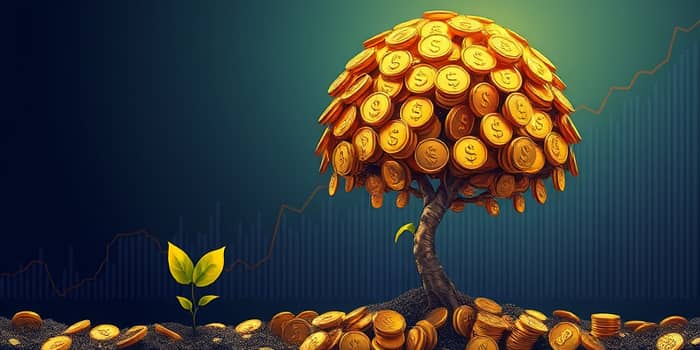
Albert Einstein reportedly called compound interest the “eighth wonder of the world.” Once you grasp its power, you’ll see why. This article explores how reinvesting returns creates exponential growth that outpaces simple interest and transforms your financial future.
Compound interest is the process of earning interest on both your initial deposit and on all accumulated interest from prior periods. Unlike simple interest, which grows your investment at a fixed linear rate, compound interest accelerates over time. Early contributions and consistent reinvestment allow the base amount to expand, generating interest on interest in subsequent periods.
Imagine planting a seed that not only grows into a tree but produces new seeds that each develop their own trees. That is the magic of compound interest: exponential growth over time, where small early contributions can multiply into substantial wealth over decades.
The standard formula for compound interest calculates the final amount after t years:
A = P (1 + r/n)^{n t}
Where:
When compounding continuously (n → ∞), the formula becomes A = P e^{r t}, where e (~2.718) drives the effective rate. This approach yields the maximum theoretical growth for a given rate and time.
To illustrate, consider various scenarios with a principal of $1,000 and a 5% rate over 10 years. The frequency of compounding dramatically affects the final amount.
Even small increases in compounding frequency yield additional returns. Over long horizons, the difference compounds significantly.
Manual calculations can become tedious, especially when solving for unknown variables or handling multiple deposits. Fortunately, free online calculators and spreadsheet functions simplify the process.
By experimenting with these tools, you can visualize how small changes in rate, timing, or deposit frequency influence your long-term outcome.
To harness the full potential of compound interest, focus on three key strategies:
Even modest increases in your regularly scheduled contributions can lead to substantial long-term gains. For instance, adding just $50 per month to a 5% portfolio over 30 years can more than double your ending balance compared to no contributions.
While compound interest is a force for building wealth, it also works against you when applied to debt. High-interest credit cards or loans can grow rapidly if not managed carefully.
Other considerations include:
Balancing these factors ensures your compounding strategy remains resilient under changing market conditions.
Compound interest transforms small, disciplined investments into a powerful engine for wealth creation. By understanding the underlying formulas, leveraging calculators, and adhering to sound contribution habits, you can maximize growth and achieve your financial goals.
Remember, time is your greatest ally. The earlier you begin and the more consistently you invest, the more dramatic the compounding effect. Let the “eighth wonder of the world” work in your favor and watch your money flourish.
References